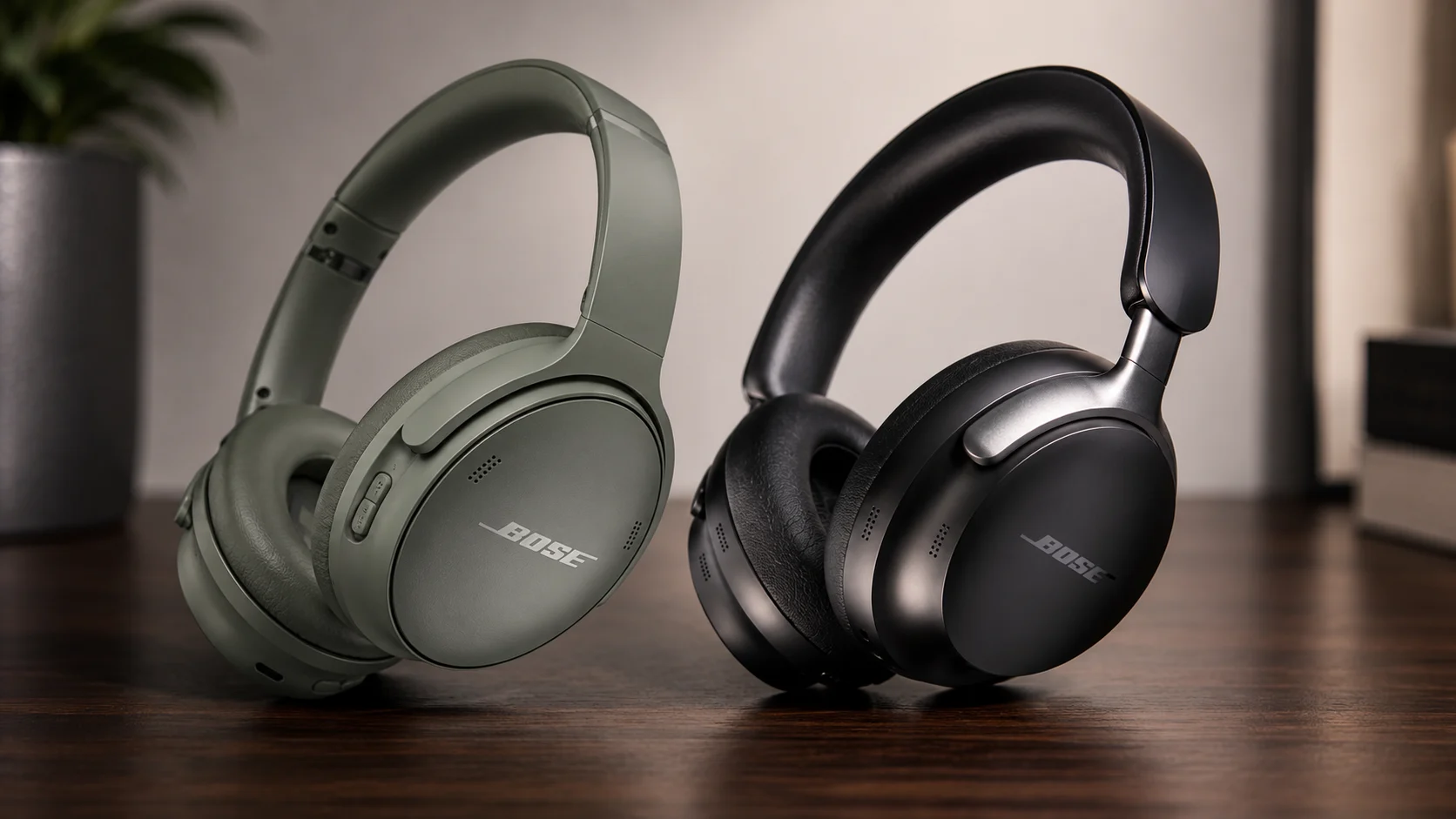
If you’ve been shopping for a serious pair of noise-cancelling headphones, you’ve almost certainly landed on Bose. And if you’re looking at Bose specifically, you’ve probably noticed something confusing: there are two headphones with nearly identical names sitting at two different price points, and neither has a number to help you tell them apart.
That’s the situation Bose created when they dropped both the QuietComfort Headphones and the QuietComfort Ultra Headphones in late 2023. I’ve spent considerable time with both commuting, grinding through work calls, long-haul travel, and too many late-night YouTube rabbit holes to count. This comparison breaks down what actually separates these two, who each one suits best, and whether the Ultra is genuinely worth the extra spend.
Spoiler: the answer isn’t as straightforward as the price difference suggests.
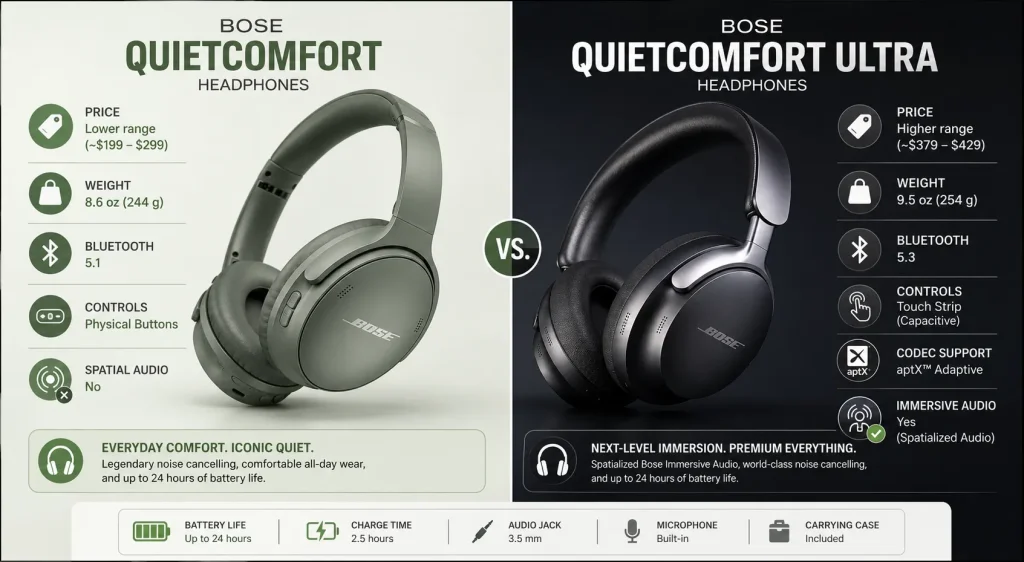
Quick Specs Comparison
| Feature | Bose QuietComfort | Bose QuietComfort Ultra |
|---|---|---|
| Price (launch) | ~$349 | ~$429 |
| Weight | ~240g (8.4 oz) | ~253g (8.8 oz) |
| Bluetooth | 5.1 | 5.3 |
| Codecs | SBC, AAC | SBC, AAC, aptX Adaptive |
| ANC | Yes (adaptive) | Yes (adaptive, upgraded) |
| Immersive Audio | No | Yes |
| Battery Life | Up to 24 hrs | Up to 24 hrs (18 hrs w/ Immersive) |
| Quick Charge | 15 min → 2.5 hrs | 15 min → 2.5 hrs |
| Controls | Physical buttons | Capacitive touch |
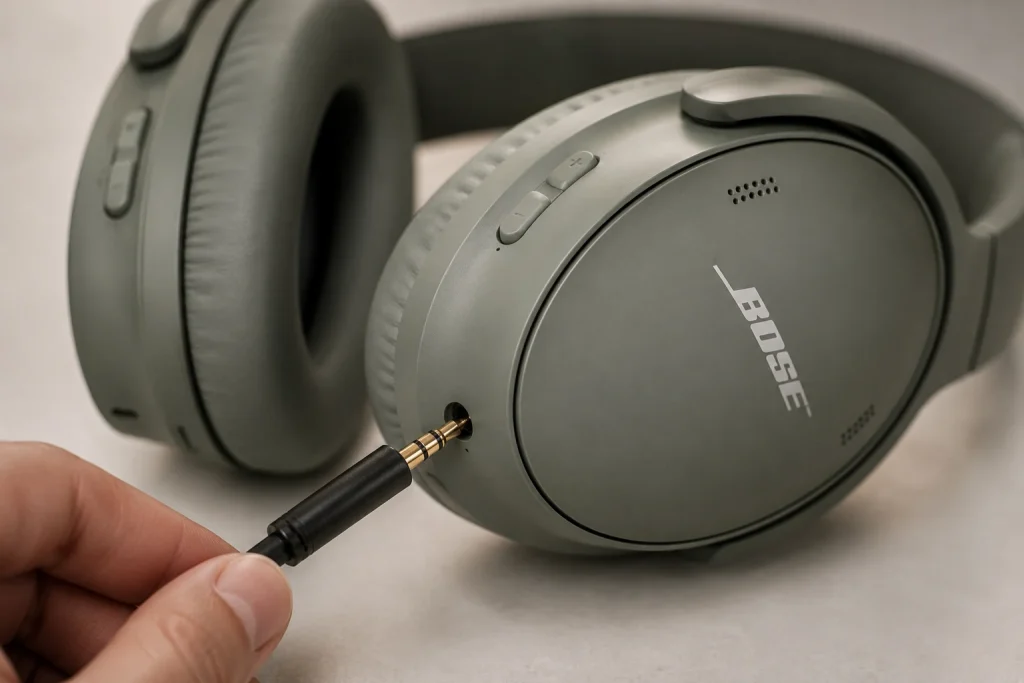
| Wired Option | 3.5mm jack | 2.5mm to 3.5mm cable |
| Folding Design | Yes | Yes |
| App Support | Bose Music app | Bose Music app |
| Multipoint | Yes | Yes |
| Mic Setup | Built-in | Built-in (improved) |

Is the Bose QuietComfort Headphones Good?
Short answer: yes, really good. Arguably embarrassingly good for what it costs now that prices have dropped.
What I Like
- ANC that genuinely works. Airplane cabin drone, open-plan office chatter, air conditioning hum all of it collapses to near-silence. The QuietComfort’s noise cancellation has always been among the best, and this iteration doesn’t disappoint.
- Lighter than you’d expect. At around 240g, they don’t dig into the top of your head the way some heavier cans do. Three hours into a work session and you forget you’re wearing them.
- Battery life is legitimately all-day. 24 hours with ANC on. That covers a long-haul flight to Tokyo, a full workday, and your commute home with battery to spare.
- Physical buttons are underrated. The clicky volume and ANC buttons on the earcup feel satisfying and work reliably even when your hands are sweaty or cold. No accidental skips from brushing your ear.
- Folds flat and packs small. The included case is compact enough to slip into a backpack side pocket without taking up meaningful space.
- Price-to-performance ratio. With regular discounts now pushing these well below $300, this is one of the best deals in premium noise-cancelling headphones.
- Passive mode still works. When the battery dies mid-flight (rare, but it happens), you can plug in the analog cable and still listen. That matters more than people admit.
What Could Be Better
- Bluetooth 5.1 feels a bit dated. Not a dealbreaker, but knowing the Ultra ships with 5.3 and aptX Adaptive stings slightly when you’re paying premium prices.
- No spatial audio. If 3D audio is your thing gaming, certain films this headphone simply doesn’t offer it.
- The headband padding is fine, not exceptional. Side-by-side with the Ultra, the difference in cushioning is noticeable. Standalone, it’s comfortable. Compared directly, slightly firmer.
- App is functional but not exciting. EQ customization exists, but it’s fairly basic. You get three-band adjustment rather than a full parametric EQ.
- The ear cup hinge feels plasticky. There’s a slight creak on some units when adjusting the fit. Not a build quality disaster, but not the premium feel you’d hope for at this price.
Pros & Cons
| Pros | Cons |
|---|---|
| Class-leading ANC | Bluetooth 5.1 only |
| Excellent 24-hour battery | No spatial/immersive audio |
| Physical button controls | Headband cushion could be softer |
| Lightweight and comfortable | Basic EQ in the app |
| Foldable + good carrying case | Slight hinge creak on some units |
| Analog cable passthrough |
Personal Recommendation
If you primarily need the best noise cancellation for commuting, office work, or travel, and spatial audio isn’t a priority, the standard QuietComfort Headphones is an exceptional buy especially now that it’s consistently available for $250–$280.
Rating: 4.4 / 5


Is the Bose QuietComfort Ultra Headphones Good?
If the standard QuietComfort is the reliable workhorse, the Ultra is what happens when Bose goes premium without restraint. It’s a noticeable upgrade in several ways though not every upgrade will matter to every buyer.
What I Like
- ANC is marginally better than the standard model. The gap is smaller than marketing suggests, but in genuinely loud environments train stations, loud cafes the Ultra edges ahead in how effectively it handles mid-frequency noise, not just low rumble.
- Immersive Audio is genuinely impressive for the right content. Watching films with spatial audio tracks, it creates a subtle but real sense of sound staging that standard stereo headphones can’t replicate.
- aptX Adaptive codec. For Android users with supported devices, this opens up noticeably better audio quality. On a Snapdragon-powered phone, the difference in detail retrieval is real.
- Premium materials feel substantial. The ear cushion padding is softer and more luxurious. The headband padding has more give. The difference from the standard QC is meaningful over a three-hour session.
- Touch controls work better than expected. Sliding a finger along the earcup to adjust volume becomes second nature quickly, and it looks sleeker than button mashing.
- Metallic accents and build quality. The aluminum and leather-like materials feel more durable and premium compared to the standard model’s all-plastic construction.
- Carries case is a step up. The hard shell case feels more protective and sits more securely, though it’s slightly bulkier.

What Could Be Better
- Immersive Audio kills battery life. Drop from 24 hours down to roughly 18 with Immersive Audio running. That’s a meaningful trade-off on long trips.
- Touch controls misfire occasionally. If your ear brushes the cup adjusting the headphones, it can accidentally pause playback. Happened to me more than once while on a call.
- Heavier than the standard model. Only 13 grams difference, but it’s noticeable on longer sessions. Nothing dramatic, but present.
- The price premium is hard to fully justify. For most listening scenarios, the gap in audio quality over the standard QC is subtle at best.
- No waterproofing on either model. Caught in a light drizzle, I found myself anxious. Neither model has an IP rating.
Pros & Cons
| Pros | Cons |
|---|---|
| Best-in-class ANC | Immersive Audio drains battery |
| aptX Adaptive codec (Android) | Touch controls occasionally misfire |
| Immersive Audio / spatial sound | Costs noticeably more |
| Premium ear pad materials | Slightly heavier |
| Bluetooth 5.3 | No IP rating |
| Cleaner, sleeker design |
Personal Recommendation
If you want the absolute best Bose has to offer in a traditional headphone form factor especially if you’re an Android user who can take advantage of aptX Adaptive the Ultra justifies its price. For iPhone users or those who don’t care about spatial audio, the gap shrinks considerably.
Rating: 4.6 / 5


Detailed Head-to-Head Comparison
1. Sound Quality
The standard QuietComfort produces warm, full-bodied sound with slightly elevated bass a Bose signature that’s remained consistent across generations. Vocals sit naturally in the mix, and the soundstage is decent without being particularly wide.
The Ultra adds measurable width and depth. With aptX Adaptive running on a compatible Android phone, there’s more air in the upper midrange, instruments feel slightly more separated, and the overall presentation is more refined. It’s not night-and-day different it’s more like the difference between a good restaurant and a really good restaurant.
✅ My Take: Ultra wins on technical performance. The gap is small for casual listening but real for focused music sessions.
| QC Headphones | QC Ultra | |
|---|---|---|
| Sound quality | 4.3/5 | 4.6/5 |
2. Bass Performance
Both headphones have satisfying bass, tuned to a consumer-friendly warmth rather than audiophile neutrality. The standard QC can occasionally feel a touch boomy on bass-heavy EDM or hip-hop if you haven’t adjusted the EQ. The Ultra is slightly more controlled and textured in the low end.
Neither is going to satisfy a true bass-head who wants skull-rattling impact. Both are genuinely enjoyable for podcasts, pop, and cinematic scores.
✅ My Take: Marginally better control on the Ultra. Standard QC is more than satisfying for most people.
3. Comfort
Both are among the most comfortable headphones in their class. The standard QC is lighter (about 240g vs 253g) and that helps on very long sessions. The Ultra’s softer ear cushion material, though, provides a more plush seal.
I wore both on consecutive days of long train commutes. The QC Ultra felt marginally better during hour three and beyond, purely because of the ear pad softness. The QC was comfortable but slightly firmer against the ears.
One thing to note: the Ultra’s touch control panel on the earcup is slightly raised. After a few hours, if you rest the headphones on a table and pick them up repeatedly, you notice it. Minor, but real.
✅ My Take: Ultra is more plush. QC is lighter. For travel, QC might actually win on long-haul comfort due to the weight.
| QC Headphones | QC Ultra | |
|---|---|---|
| Comfort | 4.5/5 | 4.7/5 |
4. ANC / Passive Isolation
Both deliver excellent active noise cancellation. The QC’s ANC is the same adaptive system Bose has been refining for years it handles continuous drone exceptionally well. Office air conditioning, flight engine noise, background traffic: near-complete silence.
The Ultra’s ANC is perceptibly better when dealing with louder, more variable environments busy station platforms, loud cafes with unpredictable noise spikes. It handles those transient sounds slightly more aggressively.
That said, the difference is subtle enough that most users would never notice. If you’re primarily using these in planes and quiet offices, the standard QC is completely sufficient.
✅ My Take: Both excellent. Ultra has a marginal edge in truly chaotic environments.
| QC Headphones | QC Ultra | |
|---|---|---|
| ANC | 4.6/5 | 4.8/5 |

5. Battery Life
Both claim 24 hours with ANC enabled. In practice, both hit close to that figure. The QC Ultra drops to around 18 hours if you’re running Immersive Audio a trade-off worth knowing about before committing.
Quick charge is identical: 15 minutes gets you about 2.5 hours of playback on both. USB-C on both. Fine.
✅ My Take: Equal, unless you use Immersive Audio constantly. Then QC wins.
| QC Headphones | QC Ultra | |
|---|---|---|
| Battery life | 4.5/5 | 4.3/5 (with Immersive on) |
6. Controls
The standard QC uses physical buttons. Press to change volume, press to switch ANC modes. Simple, tactile, reliable. Works with winter gloves on.
The Ultra uses capacitive touch on the right earcup for volume (slide up/down) and a button for ANC modes. Looks cleaner. The touch gesture becomes intuitive fast. But and I noticed this during calls if you’re adjusting how the headphones sit and your finger grazes the panel, it can trigger a volume change or pause. Annoying when you’re mid-sentence.
✅ My Take: Depends on preference. Physical buttons win for reliability. Touch wins for aesthetics.
7. Call Quality
Both have built-in microphone arrays for calls. In a quiet room, both sound clear and acceptable for video calls and phone calls. In noisier environments, both struggle somewhat voices can sound slightly hollow or processed to the person on the other end.
The Ultra’s microphone setup is reportedly improved, and in my experience it did perform marginally better in louder environments.
✅ My Take: Ultra edges ahead, but neither is going to replace a dedicated headset for professional call use.
8. Value for Money
The standard QC consistently sits around $250–$280 at most major retailers now. At that price, it’s remarkable. The Ultra still tends to hover around $330–$380.
If you can find both at roughly the same discount, the Ultra becomes a much easier recommendation. At full price, the $80 premium requires you to genuinely value aptX Adaptive, spatial audio, and the premium materials.
✅ My Take: QC wins on pure value. Ultra wins if you care about the extra features it delivers.
| QC Headphones | QC Ultra | |
|---|---|---|
| Value | 4.7/5 | 4.3/5 |
Full Comparison Summary
| Category | QC Headphones | QC Ultra |
|---|---|---|
| Sound Quality | 4.3/5 | 4.6/5 |
| Bass | 4.2/5 | 4.4/5 |
| Comfort | 4.5/5 | 4.7/5 |
| ANC | 4.6/5 | 4.8/5 |
| Battery | 4.5/5 | 4.3/5 |
| Call Quality | 4.0/5 | 4.2/5 |
| Controls | 4.4/5 | 4.3/5 |
| Value | 4.7/5 | 4.3/5 |
| Overall | 4.4/5 | 4.6/5 |
Overall Verdict
Here’s the honest version: both headphones are excellent, and the right choice depends almost entirely on how you plan to use them and what you care about.
Buy the Bose QuietComfort Headphones if:
- You primarily need world-class noise cancellation for commuting, flying, or office work
- You prefer physical button controls
- You’re on iPhone or don’t care about advanced codecs
- You want the best bang-for-buck in the Bose lineup
- You’d rather spend less and get 95% of the performance
Buy the Bose QuietComfort Ultra Headphones if:
- You’re on Android and can use aptX Adaptive
- Spatial/Immersive Audio matters to you (films, gaming, certain music)
- You want the absolute best Bose materials and build quality
- You plan to use these as a long-term daily driver and want premium feel
- The price gap is currently small at the time you’re shopping
Personally, if I was buying today at current street prices? I’d lean toward the standard QuietComfort unless I found the Ultra on significant discount. The ANC difference is real but modest. The sound upgrade matters more in focused listening. The premium materials on the Ultra are genuinely nicer but not $80–$100 nicer for most people’s daily use.
If you can catch the Ultra for under $320? Buy the Ultra. Clear.
Full Technical Specifications
| Spec | Bose QuietComfort | Bose QuietComfort Ultra |
|---|---|---|
| Type | Over-ear, closed-back | Over-ear, closed-back |
| Weight | ~240g (8.4 oz) | ~253g (8.8 oz) |
| Driver Size | Not officially disclosed | 40mm |
| Frequency Response | 20Hz – 20kHz | 20Hz – 20kHz |
| Impedance | 32Ω | 32Ω |
| Bluetooth | 5.1 | 5.3 |
| Codecs | SBC, AAC | SBC, AAC, aptX Adaptive |
| Multipoint | Yes (2 devices) | Yes (2 devices) |
| ANC | Adaptive ANC | Adaptive ANC (improved) |
| Transparency Mode | Yes | Yes |
| Immersive Audio | No | Yes |
| Battery (ANC on) | Up to 24 hrs | Up to 24 hrs |
| Battery (Immersive) | N/A | Up to 18 hrs |
| Quick Charge | 15 min → 2.5 hrs | 15 min → 2.5 hrs |
| Charging Port | USB-C | USB-C |
| Wired Listening | 3.5mm jack | 2.5mm → 3.5mm cable |
| Controls | Physical buttons | Capacitive touch + button |
| Folding Design | Yes | Yes |
| App | Bose Music | Bose Music |
| IP Rating | None | None |
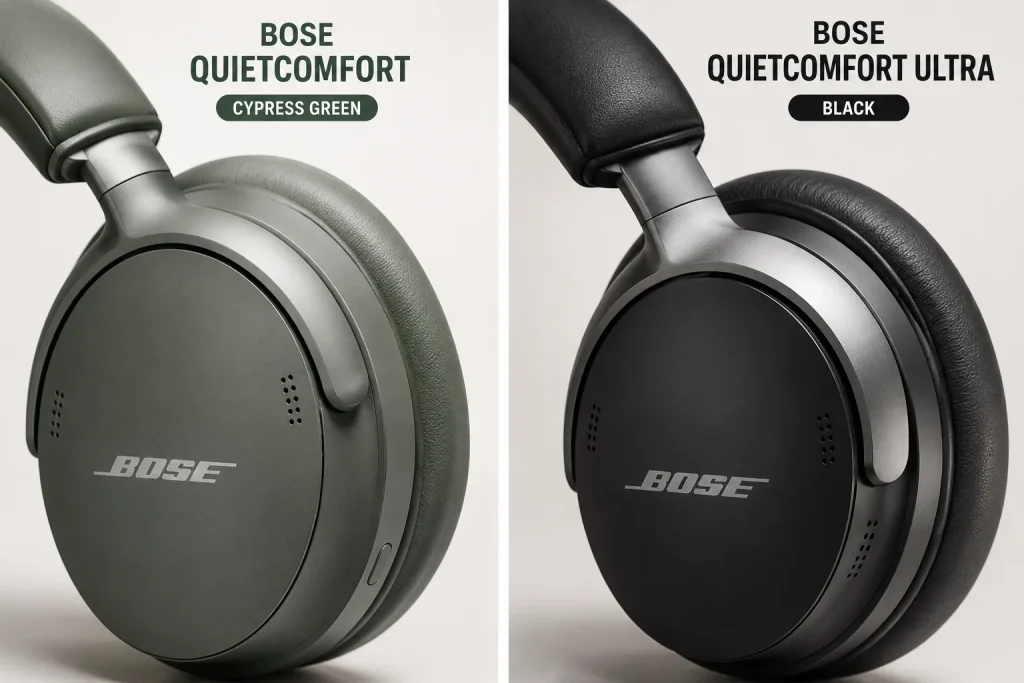
| Colors | 6+ options | 4 options |

FAQs
Q: Is the Bose QuietComfort Ultra worth the extra money over the standard QuietComfort?
It depends heavily on your use case. For casual daily commuting and office noise-blocking, the standard QuietComfort performs at about 95% of the Ultra’s level for meaningfully less money. The Ultra justifies its premium primarily for Android users who benefit from aptX Adaptive and for buyers who want spatial/Immersive Audio for films and gaming. If you’re buying primarily for ANC performance on flights or in offices, the standard model is the smarter spend.
Q: What’s the actual ANC difference between these two headphones?
Both deliver top-tier noise cancellation. In controlled environments planes, offices, light traffic both produce near-silence. The Ultra’s ANC handles unpredictable mid-frequency sounds (crowded stations, louder cafes) slightly more aggressively. The gap is real but modest. Most users in typical environments would struggle to identify which was which in a blind test.
Q: Which is better for iPhone users?
The standard QuietComfort. iPhone doesn’t support aptX Adaptive one of the Ultra’s main upgrades so that advantage disappears entirely. Both headphones support AAC, which is what Apple devices use, and both perform identically through that codec. Paying the Ultra premium as an iPhone user is harder to justify.
Q: Do these headphones work without Bluetooth?
Yes, both models include a wired listening option, though the cables differ. The standard QC uses a standard 3.5mm connection. The Ultra uses a 2.5mm to 3.5mm cable. Both can play audio in passive mode even when the battery is fully drained, which is genuinely useful on long flights.
Q: How do either of these compare to the Sony WH-1000XM5?
The Sony WH-1000XM5 is the closest competitor at a similar price point. Sony offers LDAC support (better than aptX Adaptive on paper for Android), slightly better call quality on some versions, and arguably a more detailed soundstage. Bose counters with better comfort for long sessions and marginally better ANC consistency in variable noise environments. It’s genuinely close, and testing both before committing is worth doing if you have the opportunity.
Q: Can I use these for gym workouts?
Neither headphone is sweat-rated or water-resistant. Both lack any IP certification. While light sweat during a moderate workout likely won’t cause immediate damage, neither is designed for gym use. Repeated heavy sweat sessions would be a risk. For workouts, a purpose-built sport headphone is the safer choice.