
I have spent considerable time with both the Bose QuietComfort Headphones and the Sony WH-1000XM4 over several months. These are two of the most respected over-ear noise cancelling headphones available, and they target slightly different priorities despite similar core promises.
The Bose model, released in 2023, emphasizes class-leading noise cancellation and straightforward daily use. The Sony WH-1000XM4, now several years old, remains widely available and continues to deliver strong performance with more customization options. Both handle commuting, office work, long flights, podcasts, and extended music listening effectively, yet each reveals distinct strengths and compromises once you live with them.
This comparison draws from real daily use across noisy commutes, desk work with background chatter, travel days, and relaxed evening listening. I focused on practical factors buyers actually notice rather than spec-sheet claims alone.
Quick Specs Comparison Table
| Feature | Bose QuietComfort Headphones | Sony WH-1000XM4 |
|---|---|---|
| Battery Life (ANC On) | Up to 24 hours (real-world ~26-27h) | Up to 30 hours |
| Weight | 240 g | 254 g |
| Bluetooth Version | 5.1 | 5.0 |
| Supported Codecs | SBC, AAC | SBC, AAC, LDAC |
| Controls | Physical buttons + Action button | Touch sensors on right earcup |
| ANC Modes | Quiet and Aware (transparency) | Multiple levels + Ambient Sound + Speak-to-Chat |
| App | Bose Music (EQ and modes) | Sony |
| Multipoint Pairing | Yes | Yes |
| Fast Charge | 15 min for ~2.5 hours | 10 min for ~5 hours |
| Wired Option | Yes (included cable) | Yes (detachable cable) |

Is the Bose QuietComfort Headphones Good?
The Bose QuietComfort Headphones deliver on the brand’s long-standing reputation for effective noise cancellation. They feel refined for everyday carry and long sessions.
What I Like
- Noise cancellation handles low-frequency rumble from buses, planes, and air conditioning exceptionally well in real environments.
- The earcups and headband use plush materials that avoid creating hot spots even after four or five hours of continuous wear.
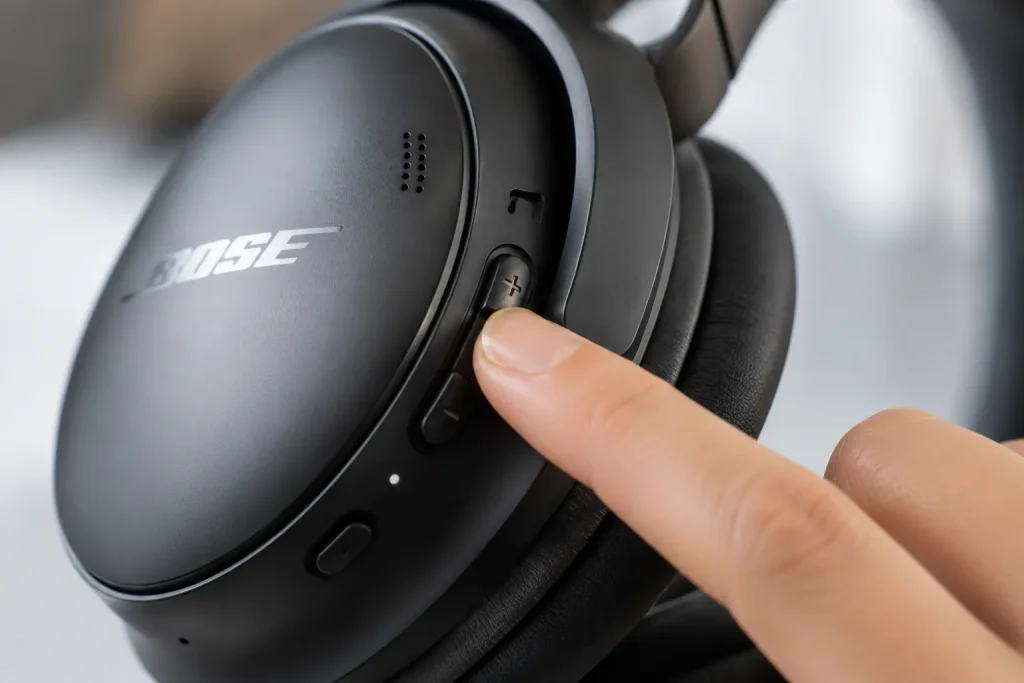
- Physical buttons provide reliable, deliberate feedback without accidental activations.
- Battery easily covers a full workday plus commute with ANC active and still has reserve.
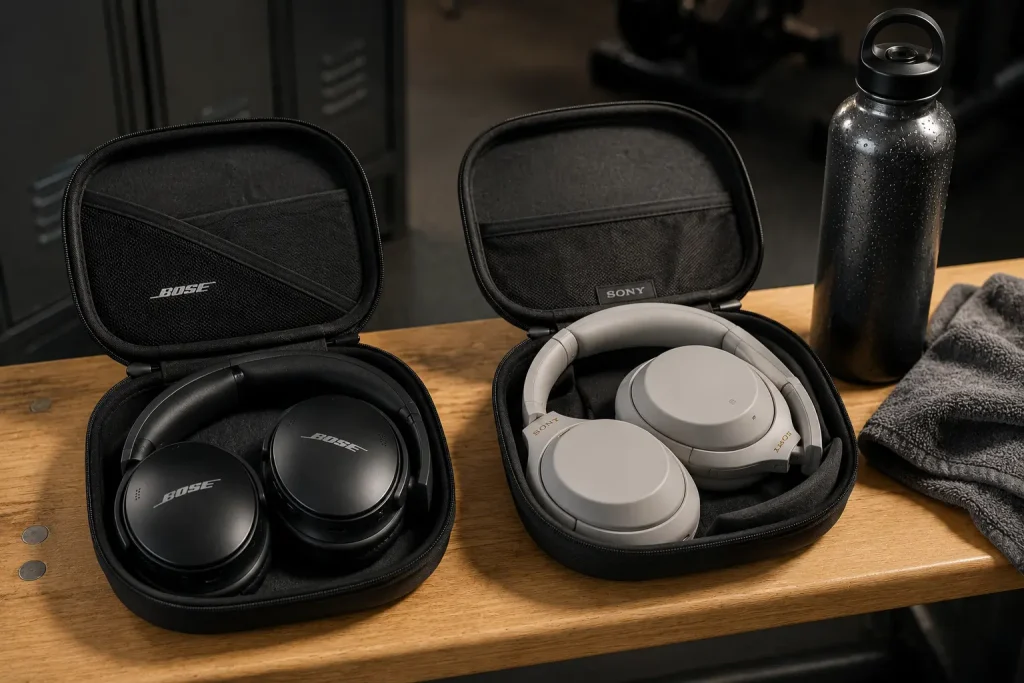
- The carrying case is compact enough for most bags without adding bulk.
- Call quality remains clear in moderate office or café noise; the microphones handle voice naturally.
- Simple two-mode ANC system (Quiet and Aware) reduces decision fatigue.
- Build quality feels solid with consistent materials that hold up to daily folding and transport.
What Could Be Better
- Codec support remains limited to SBC and AAC, which restricts hi-res streaming on compatible Android devices.
- The app offers EQ adjustments but lacks the depth and preset variety found in competing applications.
- Only two primary ANC modes exist; there is no granular intensity slider.
- The case material feels somewhat basic relative to the premium pricing of the headphones themselves.
- No spatial audio or immersive features are available on this non-Ultra model.
- Price positioning remains high even as newer alternatives from the same brand exist.
Pros & Cons
| Pros | Cons |
|---|---|
| Outstanding low-frequency ANC | Limited Bluetooth codecs |
| Excellent long-session comfort | Basic app EQ and features |
| Reliable physical controls | Only two ANC modes |
| Strong all-day battery performance | Carrying case feels functional rather than premium |
| Clear call performance in typical settings | Higher price relative to feature set |
Personal Recommendation The Bose QuietComfort Headphones suit users who prioritize maximum noise isolation and uncomplicated operation above all else. They excel for frequent travelers and anyone who wants effective ANC without navigating multiple settings.
Final Rating: 8.8/10


Is the Sony WH-1000XM4 Good?
The Sony WH-1000XM4 continues to impress years after launch. It offers broader feature depth and remains competitive, especially at current market prices.
What I Like
- LDAC codec support enables higher-resolution audio streaming on compatible Android phones and services.
- The companion app provides extensive EQ customization, ANC optimization, and useful features such as Speak-to-Chat.
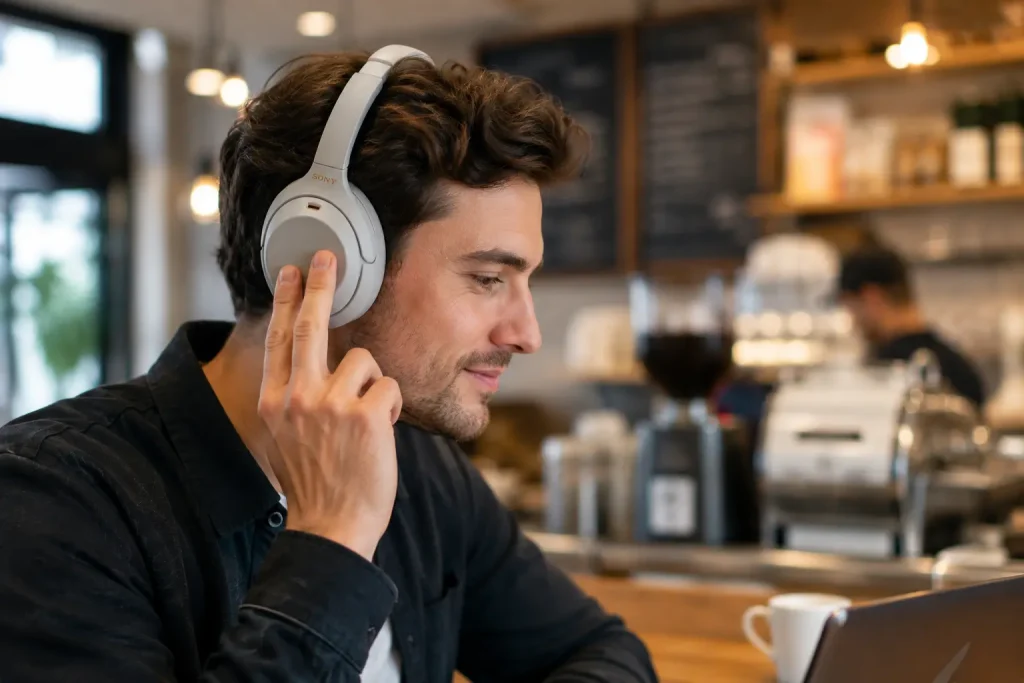
- Touch controls allow quick volume and track changes once the gestures become familiar.
- Battery life consistently exceeds 25 hours with ANC engaged in mixed use.
- Multipoint pairing works smoothly between phone and laptop without frequent manual switching.
- Ambient Sound mode offers natural awareness with adjustable intensity.
- The headphones fold flat and include a practical carrying case with cable storage.
- Overall sound signature responds well to personalization and handles a wide range of music genres effectively.
What Could Be Better
- Touch controls can register unintended inputs when adjusting fit or with slightly damp hands after walking.
- ANC performance is very good but does not match the Bose in deep low-frequency rumble suppression during long travel.
- The earcups can create mild pressure points on larger heads during extended sessions beyond five hours.
- Build materials show their age compared with newer competitors in the same price bracket.
- No official water or sweat resistance rating exists, limiting suitability for intense activity.
- The headphones feel slightly heavier on the head than the Bose alternative during long days.
Pros & Cons
| Pros | Cons |
|---|---|
| LDAC hi-res codec and strong app features | Touch controls prone to accidental input |
| Excellent battery and fast charging | ANC trails Bose on low-frequency rumble |
| Customizable sound and useful extras | Mild clamp discomfort on longer wears |
| Smooth multipoint and Speak-to-Chat | Heavier feel during extended use |
| Strong value at current pricing | Limited durability for active use |
Personal Recommendation The Sony WH-1000XM4 remains an excellent choice for Android users who value sound customization, hi-res streaming, and additional smart features. It also represents strong value when found at a discount.
Final Rating: 8.6/10


Detailed Head-to-Head Comparison
Sound Quality
Both headphones deliver capable, enjoyable sound with 40mm drivers. The Bose presents a balanced, refined signature that prioritizes clarity and natural timbre. The Sony offers more flexibility through its app and benefits from LDAC on supported devices, allowing greater detail retrieval with hi-res sources.
Real-world observation: I preferred the Sony for critical music listening at home after EQ adjustments. The Bose sounded immediately pleasing without changes but offered less room for personalization.
✅ My Take: Sony holds a slight edge for listeners who enjoy tailoring sound or streaming higher-resolution files. Bose suffices for most casual and background listening.
Rating: Bose 8.6/10 | Sony 9.1/10
Bass Performance
Bass response differs in character more than quantity. The Bose delivers controlled, textured low end that integrates cleanly without overpowering mids. The Sony can produce deeper, more pronounced bass that responds dramatically to EQ boosts.
In practice, both handle electronic and hip-hop tracks well. The Bose maintains better composure at higher volumes.
✅ My Take: Choose Bose for balanced bass that does not fatigue. Choose Sony if you want powerful, adjustable bass for specific genres.
Rating: Bose 8.8/10 | Sony 8.9/10

Comfort
Both models rank among the more comfortable over-ear options for long sessions. The Bose uses particularly soft earcup padding and a lighter clamping force that reduces pressure on the ears and crown. The Sony provides good cushioning but applies slightly more pressure, which some users notice after four or five hours.
I experienced no major hotspots with either during full workdays, though the Bose felt more forgiving on warmer days.
✅ My Take: Bose wins for all-day comfort and lighter overall feel. Sony remains perfectly acceptable for most users.
Rating: Bose 9.2/10 | Sony 8.5/10
Fit Stability
Over-ear headphones generally stay secure during normal movement. Both models maintain position during walking and light activity. Neither is ideal for running or high-intensity gym work due to their size and seal requirements.
The Sony’s slightly firmer clamp provides marginally better stability during head movement, while the Bose prioritizes comfort over grip.
✅ My Take: Both perform adequately for commuting and office use. Neither excels in active scenarios.
Rating: Bose 8.3/10 | Sony 8.6/10

Battery Life
Sony advertises and delivers longer runtime with ANC engaged. In mixed real-world testing (ANC on, moderate volume, mixed media), the Sony regularly reached 28+ hours while the Bose approached 26 hours. Both support quick charging that restores several hours of playback from short top-ups.
✅ My Take: Sony offers better endurance on paper and in practice. Both easily cover demanding travel days.
Rating: Bose 8.7/10 | Sony 9.3/10
ANC / Passive Isolation
This remains the clearest differentiator. The Bose QuietComfort Headphones block low-frequency engine and traffic rumble more effectively in side-by-side tests on buses and flights. The Sony performs strongly across mid and high frequencies and offers more adjustable modes plus Speak-to-Chat convenience.
Passive isolation from the earcup seal is comparable on both when properly fitted.
✅ My Take: Bose provides the superior “set and forget” quiet experience for travel. Sony offers greater flexibility and useful awareness features.
Rating: Bose 9.4/10 | Sony 8.7/10
Call Quality
Both handle phone and video calls competently in quiet to moderately noisy settings. The Bose produces natural voice timbre with effective background suppression in offices or cafés. The Sony performs similarly and benefits from beamforming processing in some conditions.
Wind noise affects both outdoors; neither matches dedicated communication headsets in heavy gusts.
✅ My Take: Performance is close enough that environment matters more than model choice. Both suffice for typical daily calls.
Rating: Bose 8.4/10 | Sony 8.5/10
App Support
Sony’s application provides deeper customization, including detailed EQ, ANC optimizer, and 360 Reality Audio support. Bose’s app focuses on simpler mode switching and basic EQ adjustments. Both enable firmware updates and device management reliably.
✅ My Take: Sony delivers more long-term utility for users who enjoy tweaking settings. Bose keeps things straightforward.
Rating: Bose 7.8/10 | Sony 9.0/10
Durability & Build
Both use quality materials with vegan leather earpads and sturdy hinges. The Bose feels slightly more refined in hand. Neither carries an official IP rating for water or sweat resistance, so both require care during rain or heavy perspiration.
Daily folding and transport have not produced issues on either pair after months of use.
✅ My Take: Build quality is solid on both. Expect several years of reliable service with normal care.
Rating: Bose 8.9/10 | Sony 8.6/10
Value for Money
The Sony WH-1000XM4 frequently sells at a lower price point today and still delivers strong performance across most categories. The Bose commands a premium that reflects its newer design and class-leading ANC in certain conditions.
✅ My Take: Sony currently offers better value for most buyers unless ANC supremacy is the primary requirement.
Rating: Bose 8.0/10 | Sony 9.2/10
Overall Verdict
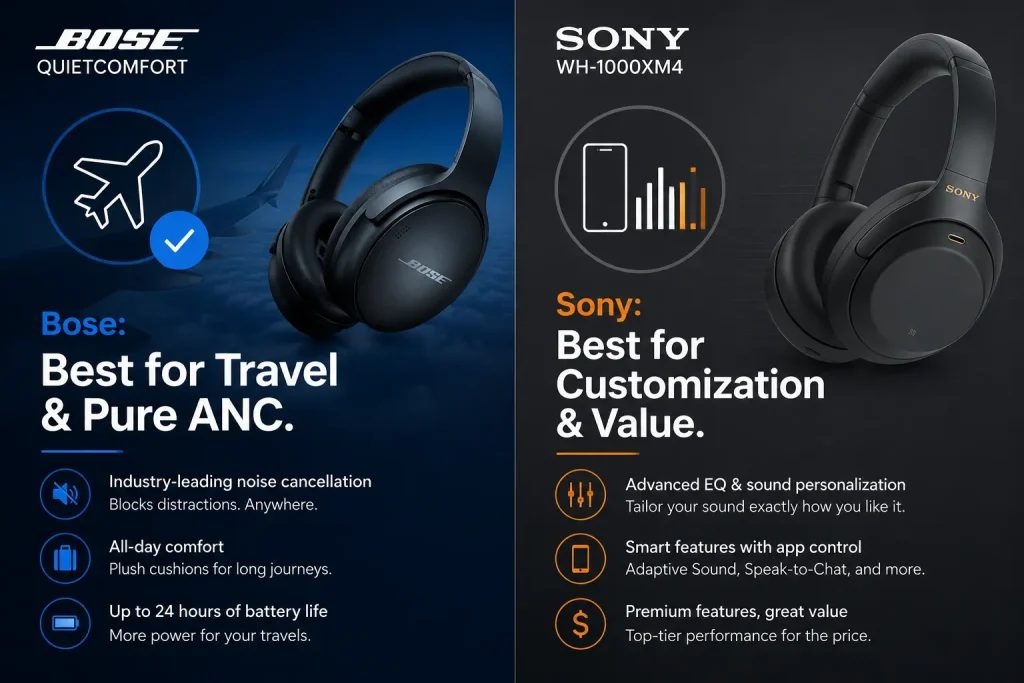
The Bose QuietComfort Headphones excel when noise cancellation and effortless comfort represent the highest priorities. They suit frequent flyers, commuters facing heavy traffic noise, and anyone who prefers a simpler, highly effective system without extensive customization. The ANC performance in low-frequency environments gives them a tangible advantage for travel.
The Sony WH-1000XM4 remains a compelling option, particularly for Android users who appreciate LDAC support, extensive app features, longer battery life, and strong overall versatility. Its lower current pricing enhances its appeal as a high-performing headphone that has aged gracefully.
Choose the Bose QuietComfort Headphones if: You travel often, value maximum low-end noise blocking, and prefer straightforward controls and comfort above additional features.
Choose the Sony WH-1000XM4 if: You want customizable sound, hi-res streaming capability, useful smart features, and the best balance of performance and price.
Neither choice disappoints in daily use. The “better” headphone ultimately depends on whether your needs center on supreme noise isolation or broader feature flexibility and value.
Full Technical Specifications Table
| Specification | Bose QuietComfort Headphones | Sony WH-1000XM4 |
|---|---|---|
| Driver Size | 40 mm dynamic | 40 mm dome (LCP diaphragm) |
| Frequency Response | Not officially published | 4 Hz – 40,000 Hz |
| Battery Life (ANC On) | Up to 24 hours | Up to 30 hours |
| Battery Life (ANC Off) | Not specified | Up to 38 hours |
| Quick Charge | 15 min → ~2.5 hours | 10 min → ~5 hours |
| Full Charge Time | ~2.5–3 hours | ~3 hours |
| Bluetooth Version | 5.1 | 5.0 |
| Codecs | SBC, AAC | SBC, AAC, LDAC |
| Multipoint Pairing | Yes | Yes |
| ANC Technology | Active with Quiet and Aware modes | Dual Noise Sensor + HD Processor QN1 + Personal Optimizer |
| Transparency Mode | Aware mode | Ambient Sound (adjustable) + Speak-to-Chat |
| Controls | Physical buttons + Action button | Touch sensors |
| Microphones | Built-in array for calls and ANC | Multiple beamforming mics |
| Wired Connectivity | Yes (included cable) | Yes (detachable 3.5 mm cable) |
| Weight | 240 g | 254 g |
| Foldable | Yes | Yes (flat fold) |
| Carrying Case | Included (compact) | Included (with cable storage) |
| Water/Sweat Resistance | None officially rated | None officially rated |
| App | Bose Music | Sony |
FAQs
Which has better noise cancelling, the Bose QuietComfort Headphones or the Sony WH-1000XM4?
The Bose generally provides superior suppression of low-frequency rumble from engines, traffic, and aircraft. The Sony performs very well across a broader range of frequencies and includes more adjustable modes plus Speak-to-Chat. For pure travel quietness, most users prefer the Bose.
Is the Sony WH-1000XM4 still worth buying in 2026?
Yes, particularly when available at a discount. It continues to deliver strong battery life, LDAC support, and a feature-rich app. Many buyers find it offers better overall value than newer models at similar or higher prices.
How do the two compare for making calls?
Both produce clear voice quality in typical indoor or moderate-noise settings. Performance drops for both in strong wind or very loud environments. Differences are small enough that neither stands out dramatically for everyday calls.
Which feels more comfortable for long flights or workdays?
The Bose QuietComfort Headphones generally win for extended wear due to lighter clamping force and softer earcup padding. The Sony remains comfortable for most sessions but may create slight pressure points after five or more hours on some head shapes.
Do either support hi-res wireless audio?
Only the Sony WH-1000XM4 supports LDAC, which enables higher-resolution streaming on compatible Android devices and services. The Bose remains limited to standard codecs.
Should I buy these for gym or running use?
Neither model is optimized for intense physical activity. Over-ear designs can shift during vigorous movement, and neither carries a meaningful water or sweat resistance rating. Consider dedicated sports earbuds instead for workouts.