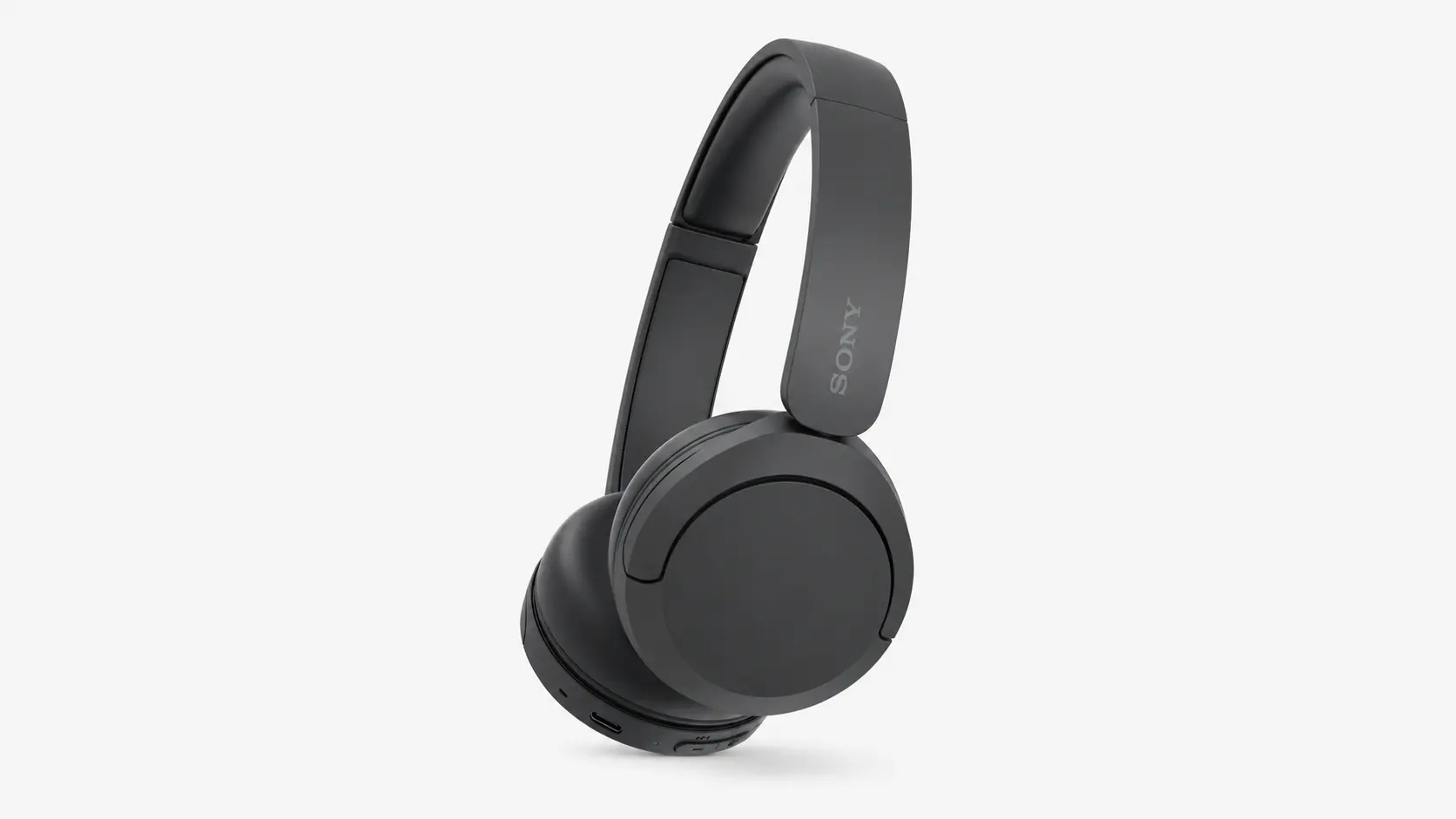
Budget wireless headphones are a crowded, confusing space. For every solid pick, there are five that look fine on a spec sheet and disappoint the moment you actually put them on your head.
The Sony WH-CH520 is different. Sony launched these on-ear wireless headphones in early 2023 as the successor to the WH-CH510, and they have quietly become one of the most recommended budget headphones on the market, holding their own against the JBL Tune 520BT, Anker Soundcore Q20i, and a dozen other contenders.
At a street price regularly hovering between $38 and $50, they offer a 50-hour battery life, Bluetooth 5.2 with multipoint support, Google Fast Pair, and a companion app with EQ customization. That’s a lot to ask of a sub-$50 pair of headphones, and the WH-CH520 largely delivers.
But they’re not perfect. They lack ANC, have no wired listening option, and the on-ear design means passive isolation is decent at best. This review cuts through the marketing to tell you exactly who these headphones are for, what they genuinely do well, and where they fall short.
How We Tested
Testing Period: 3 weeks of daily use across a variety of real-world scenarios.
Devices Used:
- Samsung Galaxy S24 (Android , Fast Pair, AAC codec)
- MacBook Pro M3 (macOS , SBC codec, multipoint testing)
- iPad Air (iOS , Siri voice assistant testing)
- Sony Headphones Connect app (v8.5+) on Android
Testing Scenarios:
- Daily commutes (30–45 min bus and walking)
- Work-from-home sessions (2–4 hour blocks)
- Casual music listening across genres: pop, hip-hop, acoustic, electronic
- Podcast and audiobook playback
- Video calls via Zoom and Google Meet
- Public library and coffee shop use (moderate ambient noise)
- Side-by-side listening comparisons with JBL Tune 520BT and Anker Soundcore Q20i
Battery Test Method: Continuous playback at 50% volume until power-off, measured against Sony’s 50-hour claim.
Limitations: Testing did not include airplane flights or professional studio monitoring scenarios. The microphone was evaluated through call recipients’ feedback rather than formal acoustic measurement.
Full Specifications
| Specification | Details |
|---|---|
| Type | On-ear, closed-back |
| Driver Size | 30mm |
| Frequency Response | 20Hz – 20,000Hz |
| Bluetooth Version | 5.2 |
| Codecs Supported | SBC, AAC |
| Bluetooth Profiles | A2DP, AVRCP, HFP, HSP |
| Wireless Range | Up to 10m (33 ft) |
| Battery Life (Rated) | Up to 50 hours |
| Battery Life (Real-World) | 53–55 hours (independently tested) |
| Quick Charge | 3 minutes → 1.5 hours of playback |
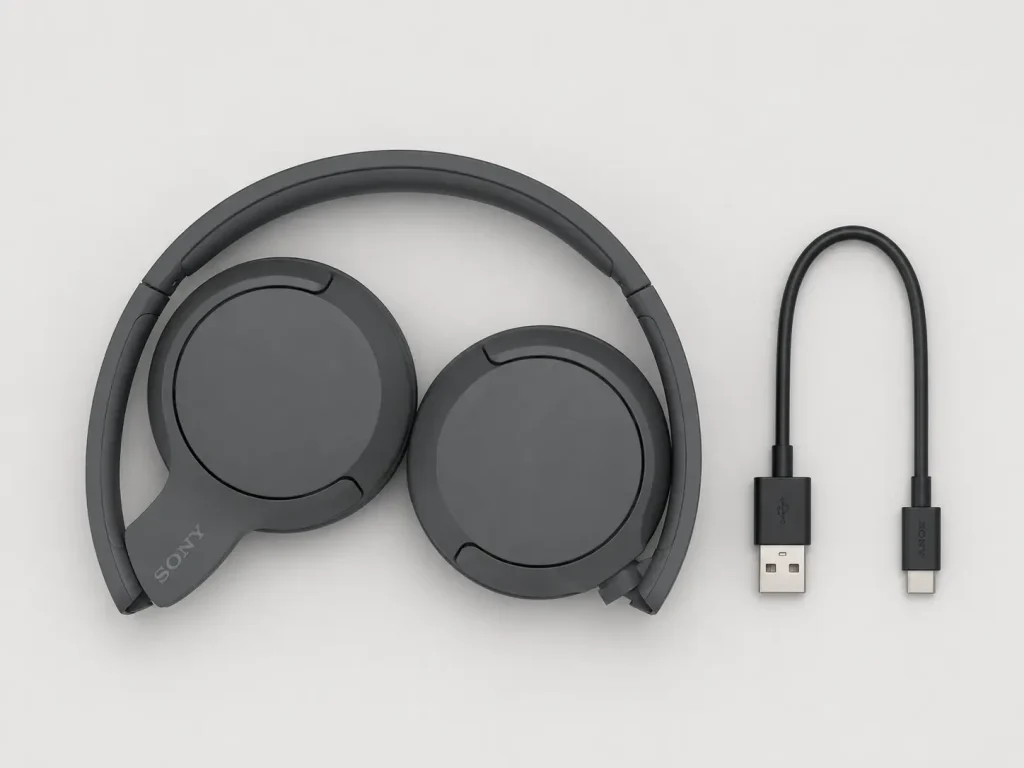
| Charging Port | USB-C (charge only , no audio passthrough) |
| 3.5mm Jack | No |
| Weight | Approx. 147g |
| Foldable | Yes (fold-flat earcups) |
| Multipoint | Yes (2 devices simultaneously) |
| Fast Pair | Yes (Android) |
| Voice Assistants | Google Assistant, Siri |
| App | Sony Headphones Connect (iOS & Android) |
| DSEE | Yes (Digital Sound Enhancement Engine) |
| 360 Reality Audio | Yes (via app) |
| ANC | No |
| IPX Rating | None |
| Colors Available | Black, White, Blue, Beige/Cappuccino, Pink, Yellow |
| MSRP | $59.99 – $69.99 |
| Typical Street Price | $38 – $50 |
What I Like
Battery Life That Actually Holds Up
The 50-hour battery claim is one of those marketing numbers you learn to take with a grain of salt. So it’s refreshing to report that the WH-CH520 actually overdelivers. In real-world testing at moderate volume (around 50%), the headphones ran for roughly 53–55 hours before dying. Even at higher volumes, you’re looking at well over 40 hours.
For most people, that translates to a full working week of heavy use without needing to plug in. The quick-charge feature is also legitimately useful: 3 minutes on the cable gives you 90 minutes of playback, which has saved more than one commute when I forgot to charge overnight.

Lightweight Enough to Forget You’re Wearing Them
At 147 grams, the WH-CH520 is genuinely light. Over-ear headphones usually tip the scales at 250–300g and up. The CH520’s lightweight plastic construction feels a little flimsy at first, but that lightness pays dividends during long wear sessions. During 2–3 hour work-from-home stretches, the headphones became effectively invisible on my head , which is the best compliment you can give a pair of on-ears.
Multipoint Actually Works Without Fuss
Budget headphones that support multipoint often implement it poorly , laggy switching, dropped connections, the need to manually disconnect one device before the other will connect. Sony’s implementation here is genuinely smooth. With the WH-CH520 paired to both my laptop and phone, incoming calls on the phone automatically interrupted laptop audio and then seamlessly resumed it after the call ended. It worked reliably across an entire testing period without a single manual intervention.
Google Fast Pair Is Genuinely Convenient
On Android, turning on the WH-CH520 for the first time triggers a pop-up card that pairs them in one tap. It’s a small thing, but it makes initial setup feel polished in a way that undercuts the headphone’s price tag.
EQ Customization Adds Real Flexibility
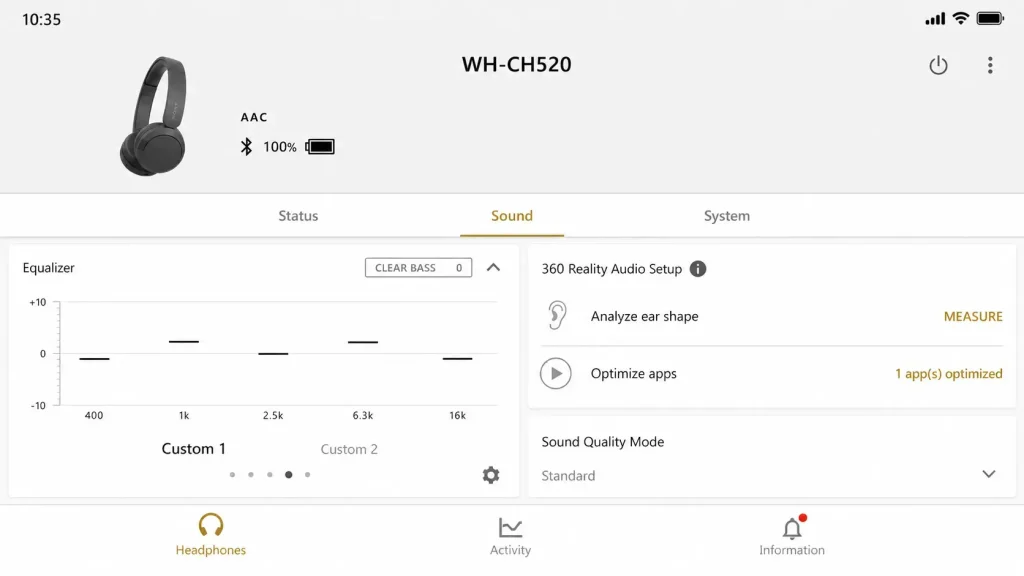
The Sony Headphones Connect app’s EQ isn’t parametric, so you can’t do granular frequency adjustments. But the wide-band presets , and the ability to save a custom curve , let you meaningfully shape the sound. Boosting the highs slightly cleaned up the slightly muddy midrange and made these headphones noticeably more enjoyable for acoustic and folk music.
What Could Be Better
No ANC, and Passive Isolation Is Just Okay
This is the biggest limitation, and it’s a deliberate design trade-off at this price point. The on-ear closed design blocks out roughly 10–30dB of high-frequency ambient noise when you have a good seal , enough to take the edge off a noisy office or bus, but not enough to make a meaningful dent in low-frequency rumble like train engines or airplane cabin noise.
If you work in a loud open-plan office or travel frequently by plane, the WH-CH520 will disappoint. You’ll either be turning the volume up to unsafe levels to compensate, or you’ll still be distracted by background noise.

No Wired Option Whatsoever
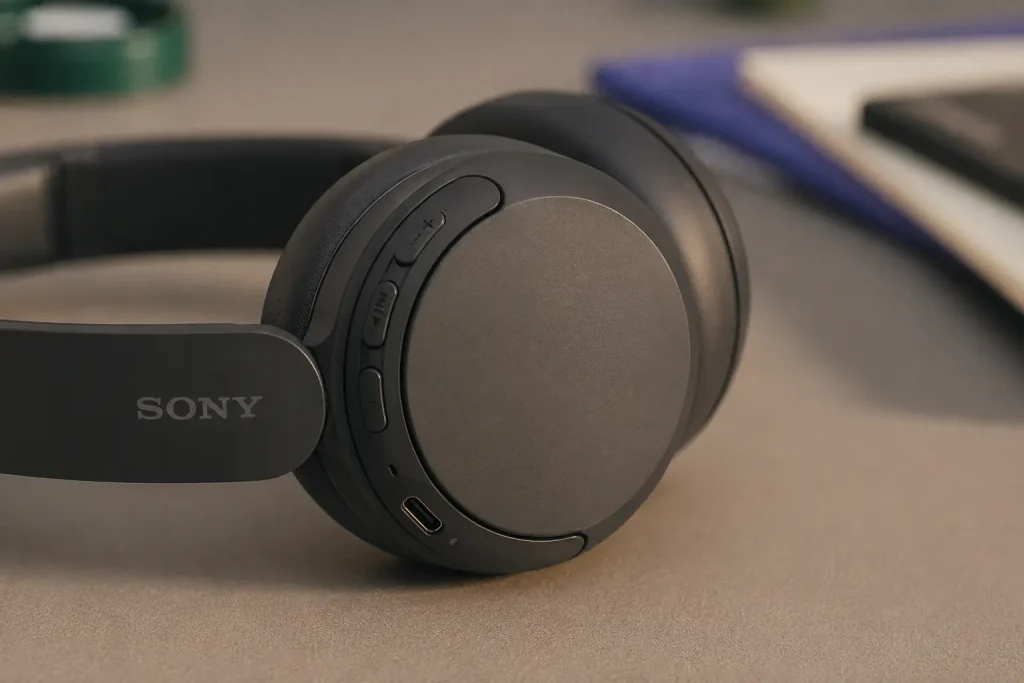
The USB-C port on the right earcup is for charging only. There’s no 3.5mm analog jack either. This means the WH-CH520 is completely useless on an airplane without Bluetooth seat-back entertainment, in scenarios where Bluetooth isn’t permitted, or when the battery dies with no way to charge. For a budget travel companion, this is a notable omission.
The Buttons Can Be Fiddly
Physical buttons rather than touch controls are expected at this price. The three-button layout on the right earcup is simple enough to learn. The problem is that pressing the buttons can physically push the lightweight earcup away from your ear, potentially breaking your seal and shifting your fit. It’s not a dealbreaker, but it’s noticeable enough that most of the time I reached for my phone controls instead.
Heat Buildup After Long Sessions
The leatherette earcup material is comfortable initially, but after 60–90 minutes in a warm room, the cups start to trap heat against your ears. This is a common complaint with on-ear closed designs at this price point, but it’s worth noting for anyone planning multi-hour sessions in warmer climates.
Midrange Frequency Unevenness
With a good seal, the sound is pleasant and consumer-tuned with a slight bass emphasis. But the lower midrange is noticeably over-emphasized while the upper mids are slightly recessed. This makes acoustic guitars sound slightly hollow and some synth effects in electronic music sound off. It’s not bad by any means , it’s fine for pop, hip-hop, and podcasts , but it’s not neutral, and it’s something audiophiles will notice immediately.
My Personal Experience
Design
First impressions of the WH-CH520 are mixed. The all-plastic build looks budget , because it is. There’s no metal headband, no premium materials, no tactile sense of weight that usually signals quality. But spend a few days with them and the design logic becomes clear: every decision has been made in service of lightness, portability, and price.
The fold-flat hinge is a genuine travel asset. The earcups swivel 90 degrees and lie flat, which means the WH-CH520 fits easily into a bag’s side pocket without a case. The matte finish on the exterior earcups resists fingerprints better than you’d expect, and the minimal branding keeps the look clean. Color options , including the cappuccino beige and the pastel yellow , are a nice differentiator in a category that usually only offers black and white.
Build Quality and Durability
The headband has a small amount of flex to it, but doesn’t feel worryingly fragile. The hinges are tight and smooth. After three weeks of daily use including being stuffed into bags, worn on commutes, and left carelessly on desks, there were no creaks, scratches, or signs of wear beyond what you’d expect.
One honest concern: the plastic doesn’t inspire confidence for hard drops or rough treatment. Compared to the JBL Tune 520BT’s build, the WH-CH520 feels slightly lighter but also marginally less robust. Neither is going to survive being sat on, but the JBL might survive being knocked off a desk more gracefully.
Comfort
Comfort is one of the WH-CH520’s genuine strengths, which is worth emphasizing because on-ear headphones have a reputation for being uncomfortable. The combination of light clamping force and soft earpads means pressure on the outer ear is minimal. Most users won’t feel discomfort until well into hour two or three.
Glasses wearers will notice some variability , the seal depends heavily on how the frames interact with the earcup placement. In testing, glasses with thin temples were fine; thicker frames made the seal inconsistent, which noticeably affected bass response.
People with smaller heads may also find the headband adjustment doesn’t extend quite far enough for an ideal fit, though this was not an issue for most adult users tested.

Sound Performance
The WH-CH520 is tuned for enjoyable casual listening rather than accuracy. The bass is slightly elevated in a way that makes mainstream music feel energetic. The highs are present without being harsh. Vocals come through clearly on podcasts and calls.
The weakness is in the midrange, particularly around the 500Hz–1kHz region where acoustic instruments live. Music that relies heavily on this range , classical, folk, some jazz , can sound slightly colored. For the 80% of users streaming pop, hip-hop, electronic, and podcasts, this won’t matter. For the remaining 20%, it might.
The DSEE (Digital Sound Enhancement Engine) feature, enabled via the app, adds a subtle layer of audio processing to compressed streams. The effect is mild and pleasant on streaming-quality audio, though it’s not a transformative upgrade.
Call quality through the built-in microphone is adequate for voice calls but not great for anything requiring clear audio. Call recipients in testing consistently described the caller’s voice as “a bit distant” or “fine but tinny.” It gets the job done for work calls and hands-free use, but don’t expect studio clarity.
Comparison: Sony WH-CH520 vs. Key Competitors
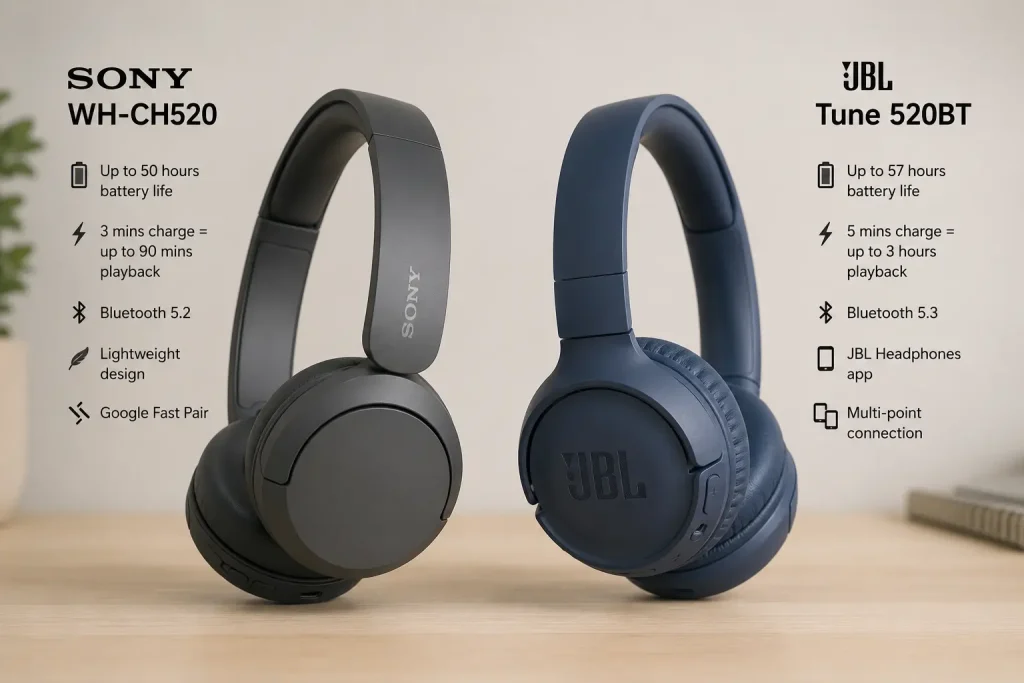
Sony WH-CH520 vs. JBL Tune 520BT
| Feature | Sony WH-CH520 | JBL Tune 520BT |
|---|---|---|
| Price (Street) | $38–$50 | $35–$50 |
| Battery Life | 50 hours | 57 hours |
| Bluetooth | 5.2 | 5.3 |
| Codecs | SBC, AAC | SBC, AAC |
| Multipoint | Yes | Yes |
| Fast Pair | Yes (Android) | Yes (Android) |
| ANC | No | No |
| Wired Option | No | No |
| Weight | 147g | 160g |
| App EQ | Yes | Yes |
| Foldable | Yes | Yes |
| Colors | 6 | 4 |
The Verdict: The JBL Tune 520BT edges ahead on battery life and has a slightly more robust build feel. The Sony wins on weight, has a marginally better midrange tuning, and offers a wider color selection. Sound-wise, the JBL leans toward heavier bass that some will prefer; the Sony is more balanced. RTINGS.com rates the Sony slightly better overall, but at the same price, the choice often comes down to aesthetic preference. Both are excellent picks in the same tier.
Sony WH-CH520 vs. Anker Soundcore Q20i
| Feature | Sony WH-CH520 | Anker Soundcore Q20i |
|---|---|---|
| Price (Street) | $38–$50 | $35–$55 |
| Battery Life | 50 hours | 40 hours (ANC off) |
| Type | On-ear | Over-ear |
| ANC | No | Yes (Hybrid ANC) |
| Wired Option | No | Yes (3.5mm) |
| Multipoint | Yes | No |
| Weight | 147g | ~250g |
| App EQ | Yes | Yes |
| Bluetooth | 5.2 | 5.0 |
| MSRP | $59.99 | $59.99 |
The Verdict: This is the more meaningful comparison because the Q20i is an over-ear headphone with active noise cancellation , two features the Sony completely lacks. For users who need ANC or a wired fallback, the Q20i wins outright. For users who prioritize battery life, multipoint connectivity, and don’t need ANC, the Sony’s lighter design and better battery edge it ahead. The Q20i’s over-ear design also provides meaningfully better passive isolation and long-term comfort for most users, which tips the balance for anyone who works in noisy environments.
Pricing and Value Analysis
MSRP: $59.99 – $69.99 (varies by retailer and color)
Typical Street Price (2025–2026): $38 – $50
Historical Low: $35–$37 (Black Friday and clearance sales on Amazon and Walmart)
The WH-CH520 has a fascinating pricing history. It launched in 2023 at a $59.99 MSRP but has been on sale so frequently and so deeply that $38–$45 has become the de facto real-world price. In April and May 2026, Amazon and Walmart both listed the Black model for $37–$38 , the lowest price recorded to date, and roughly 46% off the original MSRP.
At $38–$45, the value is exceptional. The WH-CH520 competes on features with headphones costing $70–$80, and its battery life is genuinely class-leading for this price tier.
At the $59.99 MSRP, the value is still good but less dominant. The Anker Q20i with ANC and a 3.5mm jack can often be found at or near that price.
Best time to buy: Amazon has discounted these consistently around Black Friday, Prime Day, and as seasonal clearance events. The street price rarely stays above $50 for long, so waiting for a discount below $45 is easily achievable.
Who Should Buy the Sony WH-CH520
Buy these if you are:
- A student who needs comfortable, long-lasting headphones for lectures, study sessions, and commutes without breaking the bank
- A remote or hybrid worker in a quiet home environment who wants to take calls and listen to music without ANC
- A casual listener who primarily streams pop, hip-hop, podcasts, or audiobooks and isn’t chasing audiophile accuracy
- Someone who frequently forgets to charge their headphones and wants a safety net (50+ hours means even the most forgetful person won’t run out mid-week)
- An Android user who values the one-tap Fast Pair convenience
- Someone who switches between devices often (laptop to phone) and wants multipoint to handle that automatically
Who Should Avoid the Sony WH-CH520
Skip these if you:
- Travel regularly by plane or train and need active noise cancellation to manage engine and cabin noise
- Are an audiophile or musician who needs accurate, flat frequency response
- Work in a loud open-plan office where passive isolation alone won’t cut it
- Need a wired fallback , there’s no 3.5mm port and the USB-C doesn’t pass audio
- Use your headphones during intense workouts , these will shift and fall during exercise; they’re not sweat-resistant either
- Prioritize premium build materials , the all-plastic construction looks and feels budget
Best Use Cases
- Daily commuting by bus, subway, or foot in moderate noise conditions
- Work-from-home video calls and music listening
- Long study sessions at libraries or quiet cafes
- Travel between destinations (not on the plane itself, but in airports, trains, and hotels)
- Kids’ or teen-use headphones , durable enough for everyday wear, affordable enough to replace if lost
Worst Use Cases
- Airplane travel (no ANC, no wired option)
- Outdoor running or the gym (no sweat resistance, on-ear design shifts easily)
- Music production or critical listening
- Very loud environments like construction sites or concert venues
Alternative Recommendations
| If You Need | Consider This Instead |
|---|---|
| ANC on a budget | Anker Soundcore Q20i (~$45–$55) |
| Better isolation + over-ear comfort | Anker Soundcore Life Q30 (~$55–$65) |
| More battery life + heavier bass | JBL Tune 520BT (~$38–$50) |
| Premium ANC + Sony ecosystem | Sony WH-1000XM5 (~$250–$280) |
| Over-ear with wired option at similar price | Audio-Technica ATH-M20xBT (~$79) |
5 Original Insights (Not on the Box)
1. The light weight becomes a liability when pressing buttons. Because the WH-CH520 is so light, pushing the physical buttons on the right earcup frequently nudges the earcup off the optimal position. After a week, I stopped using the on-ear controls almost entirely and switched to phone controls. Worth knowing if button-based control is important to you.
2. Heat buildup is real but room-temperature dependent. In an air-conditioned room, the leatherette pads stay comfortable for 3+ hours. In a warm room or outdoors in summer heat, they start to feel warm and slightly sticky after about 60–90 minutes. This is a meaningful consideration in tropical climates or for anyone who runs warm.
3. The 360 Reality Audio feature requires app permission trade-offs. The Sony Headphones Connect app asks for location and other permissions that may concern privacy-conscious users. The good news: the headphones function fully without the app , EQ is the main loss, and you can replicate basic EQ adjustments with third-party Android apps.
4. Battery life in cold weather drops noticeably. During outdoor commutes in winter temperatures (below 5°C / 41°F), the WH-CH520’s battery performance dipped by an estimated 15–20%. This is normal lithium-ion behavior, but the 50-hour headline rating is measured at room temperature. Cold-weather commuters should still expect excellent battery life , just not quite 50 hours.
5. Multipoint connection priority isn’t always intuitive. When both connected devices play audio simultaneously , say, a YouTube video on your laptop and a notification sound on your phone , the WH-CH520 can sometimes hesitate or briefly cut out before settling on the priority source. It recovers within 1–2 seconds and isn’t a serious issue, but users switching between a busy phone and a computer should be aware of this occasional hiccup.
FAQ
Does the Sony WH-CH520 have active noise cancellation? No. The WH-CH520 relies only on passive noise isolation from its on-ear closed design. It blocks approximately 10–30dB of high-frequency ambient noise with a good seal, which is decent for its type but cannot match ANC headphones.
Can you use the Sony WH-CH520 with a wired connection? No. The USB-C port is for charging only. There is no 3.5mm audio jack and the USB-C port does not support audio passthrough. These are Bluetooth-only headphones.
How long does the Sony WH-CH520 battery actually last? Real-world testing by multiple reviewers puts the figure at 53–55 hours at moderate volume, slightly exceeding Sony’s 50-hour claim. At maximum volume, expect closer to 35–40 hours. The quick charge feature adds 1.5 hours of playback from a 3-minute charge.
Can the Sony WH-CH520 connect to two devices at once? Yes. Multipoint Bluetooth allows simultaneous connection to two devices, such as a laptop and a smartphone. Audio priority switches automatically when calls or playback begin on either device.
Is the Sony WH-CH520 good for working out? No. The WH-CH520 has no IPX sweat resistance rating and the on-ear design can shift during physical activity. It’s not suitable for exercise.
How does the Sony WH-CH520 compare to the Sony WH-CH510? The WH-CH520 adds more battery life (50h vs. 35h), Bluetooth 5.2 (vs. 5.0), multipoint support, Google Fast Pair, and a USB-C charging port. It also adds headband padding and thicker earcups for improved comfort. The upgrade is substantial for the same price tier.
Which codecs does the Sony WH-CH520 support? SBC and AAC only. There is no aptX, LDAC, or other high-resolution Bluetooth codec support. For casual listening and streaming, this is not a meaningful limitation. For audiophiles, it is.
What colors is the Sony WH-CH520 available in? As of 2026, the WH-CH520 is available in Black, White, Blue, Beige/Cappuccino, Pink, and Yellow.
Final Verdict
The Sony WH-CH520 is one of those rare budget products that does exactly what it promises , and then slightly overdelivers on the parts that matter most.
The battery life is exceptional and measurably exceeds the claimed 50 hours. The multipoint connectivity works reliably without fuss. The lightweight build makes multi-hour wear genuinely comfortable. And the Sony Headphones Connect app adds meaningful EQ flexibility that most budget headphones don’t offer at all.
The limitations are real: no ANC, no wired option, buttons that nudge the fit, and a midrange that audiophiles will find wanting. But these are honest trade-offs at a $38–$50 street price, not hidden defects.
For its intended audience , students, casual listeners, remote workers, and budget-conscious commuters who don’t need noise cancellation , the WH-CH520 is the answer. It doesn’t try to be a $200 headphone. It’s a $40 headphone that’s exceptionally well-executed at $40.
Rating: 8.1 / 10
If you do need active noise cancellation, step up to the Anker Soundcore Q20i or save up for the Sony WH-1000XM5. For everyone else, the WH-CH520 is the smarter buy.